Nutrition Basics for Young Athletes
By Sravan · October 4, 2026 · 9 min read
Health & Nutrition for Young Athletes · Part 1
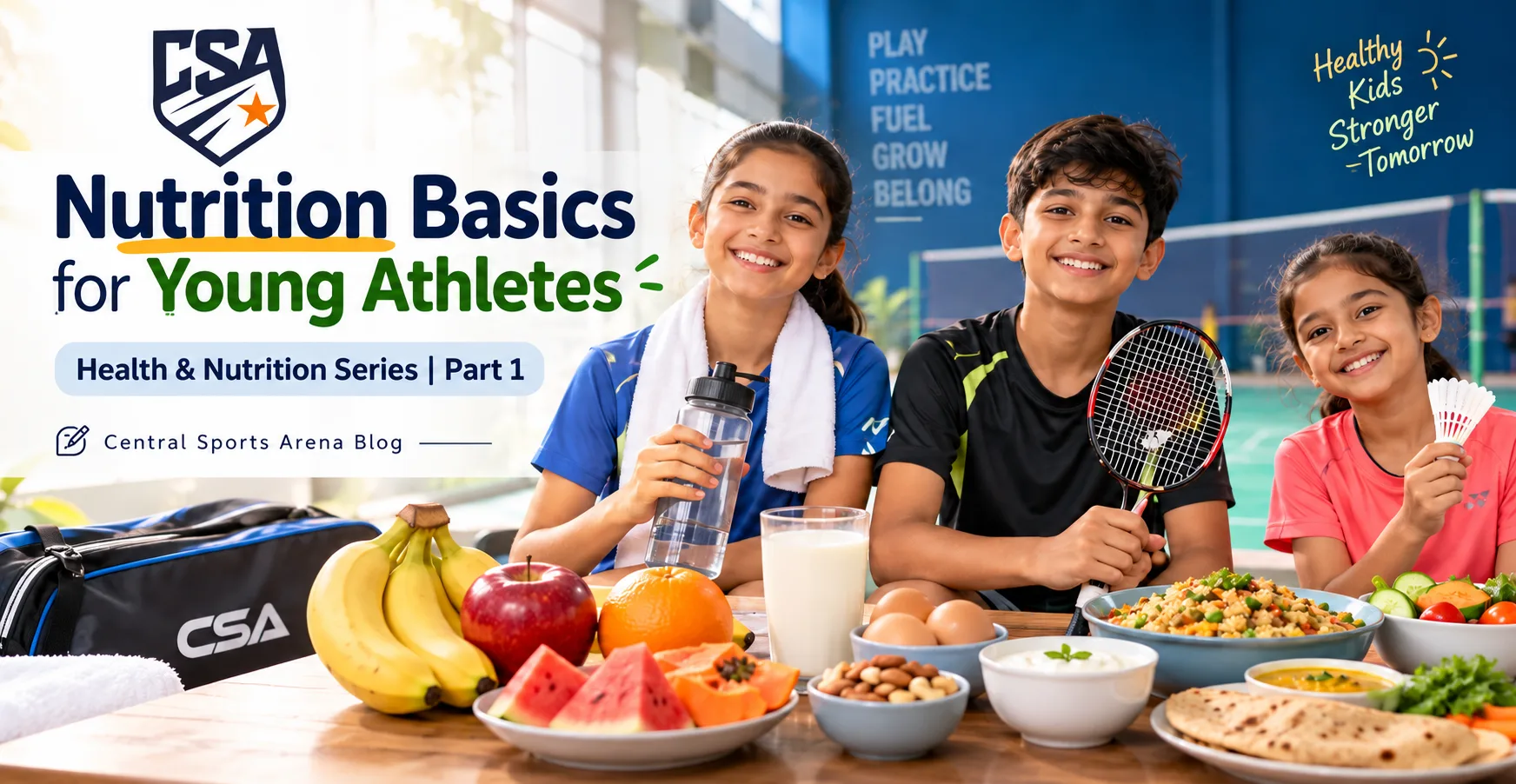
When a child starts taking sport seriously, parents naturally begin thinking beyond just coaching and practice.
Questions usually start coming up:
Is my child eating enough?
Do they need more protein?
What should they eat before training?
Is a banana enough before practice?
Should they have milk or a protein drink after training?
How much water should they drink?
Why do they sometimes look tired on court even after eating?
These are important questions.
At CSA, we believe that developing a young athlete is not only about what happens during a training session.
A child’s progress is also influenced by what happens before training, after training, at school, at home and during sleep.
That is why nutrition should be viewed as part of overall athlete development.
The good news is that nutrition for young athletes does not need to be complicated.
For most children, the foundation starts with simple everyday food, regular meal timing, adequate hydration and good recovery habits.
A Young Athlete Is Still a Growing Child
The first thing parents should remember is simple:
A young athlete is a growing child first and an athlete second.
Children need nutrition not only for sport, but also for:
Physical growth
Brain development
School concentration
Immunity
Hormonal development
Bone health
Muscle development
Recovery
Daily energy
This means we should be careful about copying adult gym diets, weight-loss plans, restrictive diets or high-protein routines for children.
The goal is not to make children “diet.”
The goal is to help them:
Grow well. Train well. Recover well.
Start With Everyday Food
Sports nutrition can sometimes sound complicated because we hear about:
Protein powders
Sports drinks
Electrolytes
Energy gels
Supplements
Recovery shakes
Nutrition bars
But for most young athletes, the first question should be:
What does their everyday food look like?
A good foundation usually comes from regular home food.
A balanced meal can include:
Carbohydrates for Energy
Examples:
Rice
Roti
Idli
Dosa
Upma
Poha
Oats
Potatoes
Millets
Fruits
Carbohydrates are one of the main sources of energy used during sport.
Children who are regularly training, running and playing need sufficient energy.
So carbohydrates should not automatically be treated as something that needs to be removed.
Protein Supports Growth and Recovery
Protein is important for growing children.
It supports:
Muscle repair
Growth
Tissue development
Recovery after physical activity
Good everyday protein sources include:
Eggs
Milk
Curd
Paneer
Dal
Rajma
Chickpeas
Sprouts
Soy
Fish
Chicken
Nuts and seeds
One common mistake is to focus only on how much protein a child eats after training.
A better approach is to include suitable protein sources throughout the day.
For example:
Breakfast → Lunch → Snack → Dinner
Protein supplements should not automatically become the first solution.
Food should generally remain the foundation.
Explore Your Estimated Protein Needs
Parents and older athletes can use the:
CSA Protein Intake Calculator
https://csa.club/health-calculators/protein-intake
This should be used as a general reference rather than a replacement for personalised nutrition advice, particularly for growing children.
Fruits and Vegetables Matter Too
Young athletes need more than calories and protein.
Fruits and vegetables provide important vitamins, minerals, fibre and other nutrients needed for overall health.
You do not need expensive imported foods.
Indian seasonal fruits are excellent options.
Examples include:
Banana
Guava
Papaya
Orange
Apple
Watermelon
Pomegranate
Mango
Sapota
Grapes
The easiest approach is:
Aim for variety across the week.
The same principle applies to vegetables.
Try to include different colours and varieties rather than depending on the same foods every day.
Hydration Is Part of Performance
Even mild dehydration can make training feel harder.
A child may appear:
Tired
Slow
Less focused
Irritable
Less energetic
Sometimes the issue may simply be that the child has not consumed enough fluids before coming to training.
A useful habit is:
Before Training → During Training → After Training
Children should have easy access to water throughout the day and during sports sessions.
Do not wait until a child says they are extremely thirsty.
Estimate Daily Water Requirements
Use the:
CSA Water Intake Calculator
https://csa.club/health-calculators/water-intake
Remember that actual fluid needs can change depending on:
Weather
Humidity
Training intensity
Duration of training
Individual sweating
Age and body size
We will cover hydration, electrolytes and sports drinks in more detail later in this series.
Meal Timing Matters
Imagine this situation.
A child finishes school, travels home or directly to the academy, eats very little and then enters a 60–90 minute training session.
During training, the coach may observe:
Low energy
Reduced concentration
Slow movement
Frustration
Poor decision-making
Reduced training quality
It can easily look like the child is not interested or not working hard enough.
But sometimes the problem started before the child even stepped onto the court.
They simply did not have enough energy available for training.
This is why timing matters.
A suitable meal or snack before training can help a child arrive better prepared.
After training, food and fluids support recovery.
We will explore pre-training and post-training nutrition in the next article.
Don't Skip Breakfast Regularly
For school-going children, mornings can become rushed.
School bags.
Uniforms.
Transport.
Homework.
Early-morning coaching.
It is very easy for breakfast to become the meal that gets ignored.
But regularly starting the day without enough food can make it harder for active children to meet their overall energy and nutrient requirements.
Breakfast does not have to be complicated.
Some practical options include:
Idli + sambar
Dosa + egg
Upma + curd
Poha + peanuts
Oats + milk + fruit
Eggs + toast
Banana + milk
Chapati + egg
Curd rice with suitable accompaniments
The right option depends on timing, appetite and whether the child is training before or after breakfast.
Snacks Can Be Useful
Active children often have long gaps between school meals, travel and sports training.
A planned snack can help bridge that gap.
Simple options can include:
Banana
Fruit
Curd
Milk
Boiled eggs
Peanut chikki
Nuts
Homemade sandwich
Idli
Paneer sandwich
Roasted chana
The goal is not to make children eat continuously.
It is to avoid situations where they enter demanding training sessions completely hungry.
What About Junk Food?
Children are children.
Birthdays happen.
Ice cream happens.
Pizza happens.
Eating one less-than-perfect meal does not destroy athletic development.
Nutrition should not become a source of fear.
What matters more is the overall pattern.
Instead of aiming for perfection, aim for:
Good choices most of the time.
A sustainable routine is much more valuable than an extremely strict diet that a child cannot maintain.
Avoid Making Weight the Main Conversation
For young athletes, we should be careful about constantly discussing:
Weight
Body shape
Calories
Fat percentage
Being “thin”
Being “heavy”
Children grow at different rates.
Their bodies also change significantly during childhood and adolescence.
Nutrition should support:
Health, growth, energy and performance.
It should not create anxiety around food or body image.
Parents should avoid comparing one child’s body with another athlete’s body.
Supplements Are Not the Starting Point
Parents often ask:
“Should my child take protein powder?”
or
“Which supplement will improve performance?”
Before thinking about supplements, first evaluate:
Is the child eating enough?
Are they eating regularly?
Are they getting enough protein from food?
Are they drinking enough water?
Are they sleeping well?
Are they recovering between sessions?
A supplement cannot compensate for consistently poor eating and sleeping habits.
We will discuss supplements separately in this series because the answer depends on the individual child and should not be generalised.

Sleep and Nutrition Work Together
Good food alone is not enough.
Recovery also requires sleep.
Children who train regularly need sufficient recovery time.
Poor sleep can affect:
Concentration
Mood
Learning
Training quality
Recovery
So athlete development should be viewed as a complete cycle:
Training → Nutrition → Hydration → Recovery → Sleep → Growth
Every part matters.
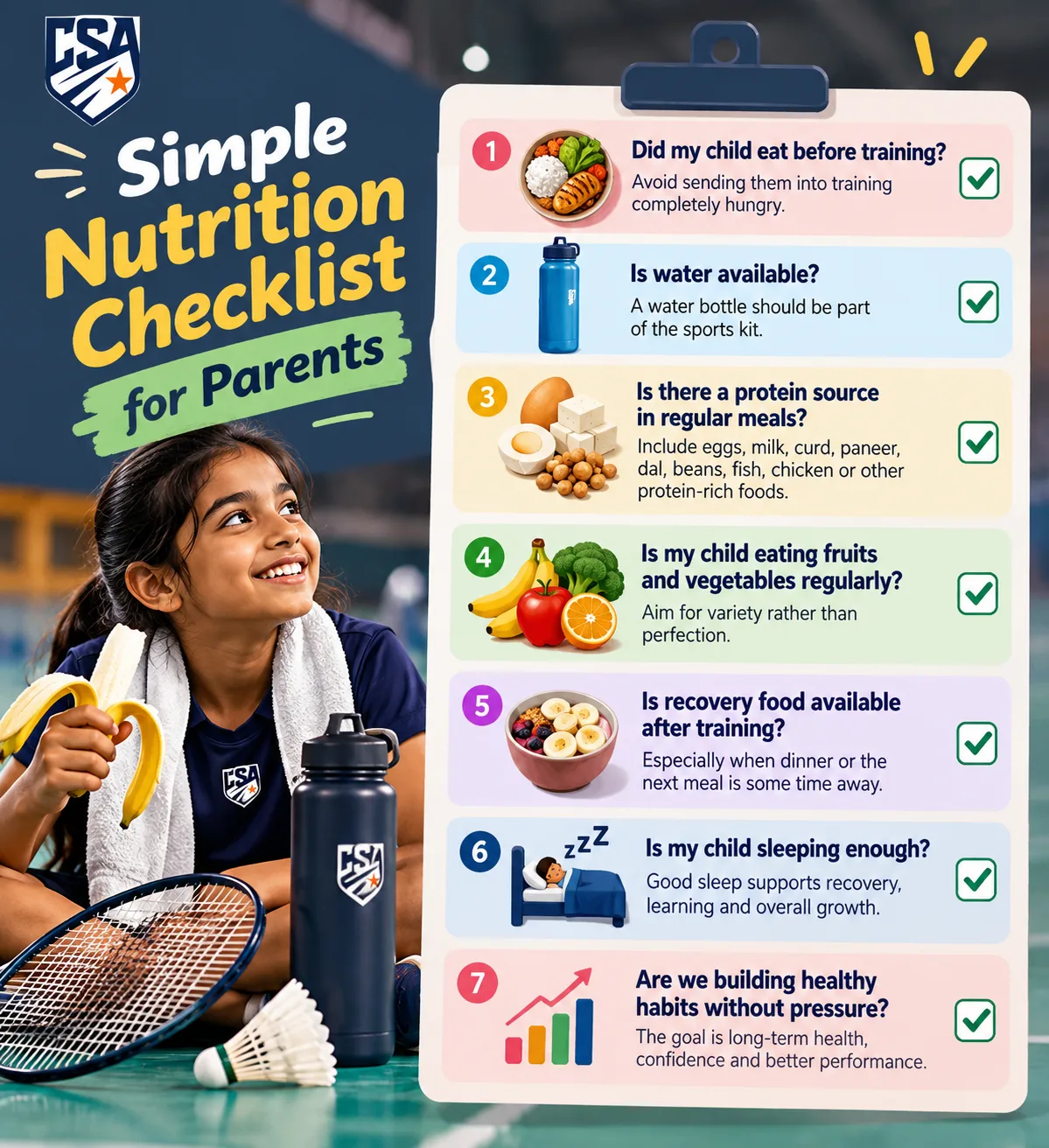
A Simple Nutrition Checklist for Parents
You do not need to completely change your child's diet overnight.
Start with these basic questions:
1. Did my child eat before training?
Avoid regularly sending children into demanding sessions completely hungry.
2. Is water available?
A water bottle should be part of the sports kit.
3. Is there a protein source in regular meals?
Eggs, milk, curd, paneer, dal, beans, fish, chicken and other everyday foods can help.
4. Is my child eating fruits and vegetables regularly?
Aim for variety rather than perfection.
5. Is recovery food available after training?
Especially when dinner or the next proper meal is still some time away.
6. Is my child sleeping enough?
Recovery continues after the training session ends.
7. Are we building healthy habits without pressure?
The long-term goal is for children to understand their own health and eventually make better choices independently.
Coach + Player + Parent
Young athlete development works best when everyone contributes.
The coach manages the training environment.
The player learns, practises and develops responsibility.
The parent plays a major role in nutrition, sleep, scheduling and recovery outside the academy.
That partnership can have a significant impact over time.
At CSA, our aim is not only to help children become better badminton players or better sportspeople.
We want them to understand the habits that support their overall development.
Because long-term progress is not built only through more training.
It is built through the combination of:
Good Training + Good Nutrition + Good Recovery + Consistency
Small daily habits repeated over months and years can make a much bigger difference than searching for shortcuts.
That is the purpose of this Health & Nutrition for Young Athletes series.
To help parents and players understand sports nutrition in a simple, practical and realistic way.
Because before we build champions, we should first help build healthy young athletes.
Coming Next
Part 2 — What Should Kids Eat Before & After Sports Training?
In the next article, we will look at:
What to eat before training
How long before training children should eat
Morning training food options
Evening training food options
What to eat after training
Practical Indian snack ideas
What to eat on heavier training days
Helpful CSA Health Tools
Water Intake Calculator
https://csa.club/health-calculators/water-intake
Protein Intake Calculator
https://csa.club/health-calculators/protein-intake
These calculators are intended as general educational tools. Children are still growing, and individual requirements can vary considerably based on age, development, health, activity level and training load.
This article is intended for general educational purposes and should not be considered individual medical or dietary advice. Parents of children with allergies, medical conditions, growth concerns, nutritional deficiencies or specific dietary requirements should consult an appropriately qualified healthcare or nutrition professional.
Explore CSA: Health calculators · Water intake · Protein intake · Youth badminton training
Recommended For You
Health & Nutrition
Hydration for Young Athletes
Learn how to keep young athletes properly hydrated before, during and after training. Part 3 covers daily water needs, signs of dehydration, electrolytes, sports drinks, hot-weather training and simple tournament-day hydration habits.
Oct 17, 2026

Health & Nutrition
What Should Kids Eat Before & After Sports Training?
Help young athletes fuel training and recover better with simple food choices and smart timing. This guide covers what kids can eat before and after sports, with practical Indian meal and snack ideas for morning, evening and heavier training days.
Oct 11, 2026

Why We Exist
Why We Exist
CSA was built to make youth sports development more transparent, structured, and meaningful. Starting with badminton but designed with a broader multi-sport vision, we bring coaches, kids, and parents together to track real progress across technical skills, tactical understanding, mental strength, physical fitness, performance, and long-term growth.
Oct 4, 2026