Why We Exist
By Sravan · October 4, 2026 · 9 min read

Because every young athlete deserves to be seen, understood, and guided — beyond just a game.
Central Sports Arena was not created only to provide courts, coaching sessions, or sports infrastructure.
It was built from a much more personal experience.
Over the years, I have travelled to different places and spent a significant amount of time taking kids to multiple academies, training sessions, competitions, and tournaments.
Our journey started with badminton, but the problem we observed was much bigger than one sport.
Across youth sports, one thing kept coming back to me.
After training, the feedback was often very simple:
“Today was good.”
“He needs to improve.”
“She needs more focus.”
“Fitness needs work.”
“Performance is getting better.”
There was nothing wrong with the feedback itself.
The real problem was that, as a parent, it was difficult to understand the complete picture.
What exactly improved?
What still needs work?
Is the athlete progressing compared to three months ago?
Is physical fitness improving?
Is tactical understanding getting better?
How is the child handling pressure?
Are they becoming more confident?
What is the next milestone?
Most of this information stayed inside the coach’s observation and was shared orally, often with limited detail.
That experience became one of the biggest reasons behind building CSA the way we are building it today.
Parents invest enormous amounts of time, energy, emotion, and money in their child’s sporting journey.
But they should not have to guess whether their child is progressing.
They should be able to understand the journey.
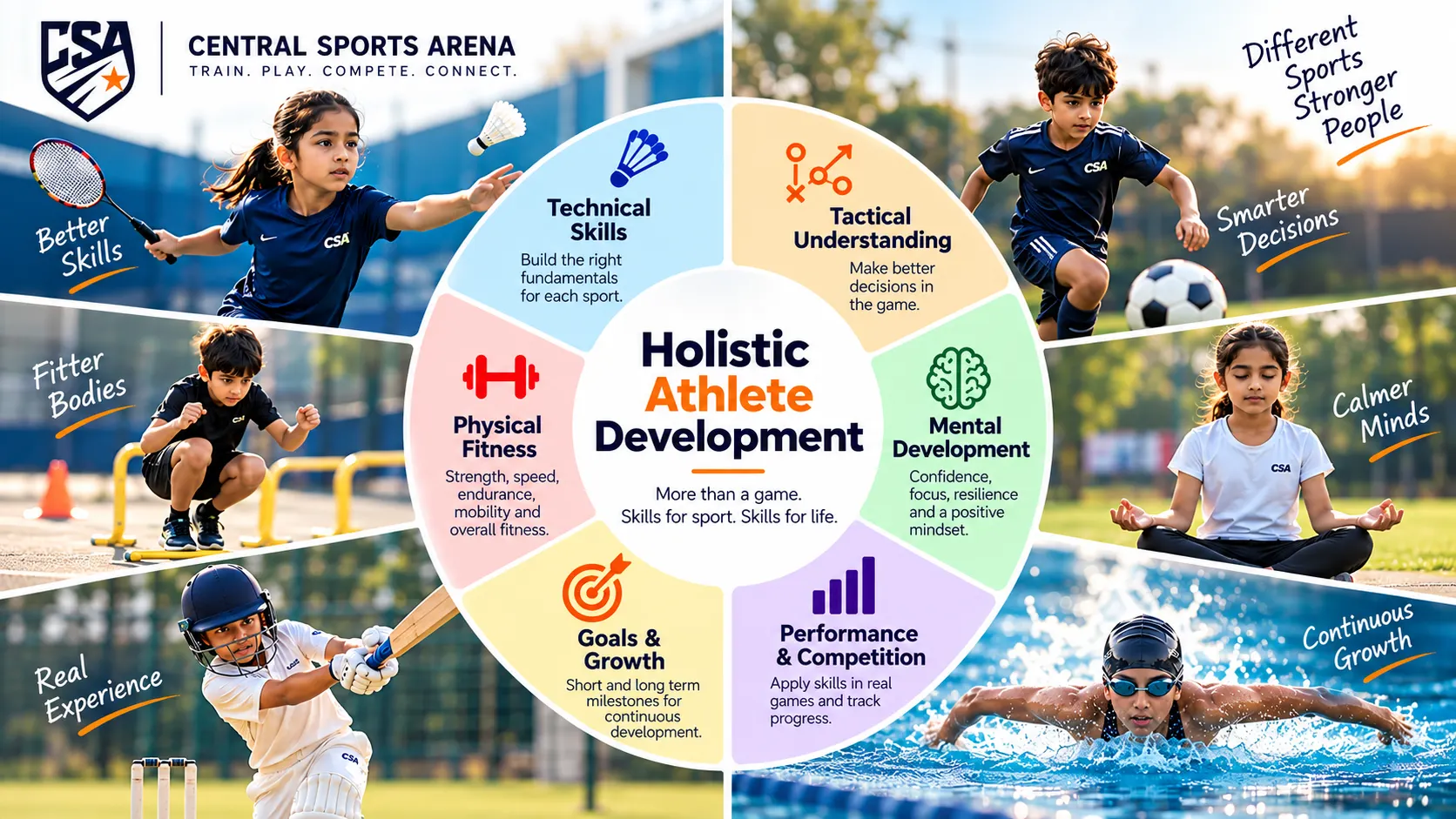
At CSA, our goal is to bring more clarity, structure, and transparency into athlete development.
That means going beyond:
attendance
match wins and losses
tournament medals
rankings
occasional verbal feedback
We want parents to understand how their child is developing over time.
Not to increase pressure.
But to create better support.
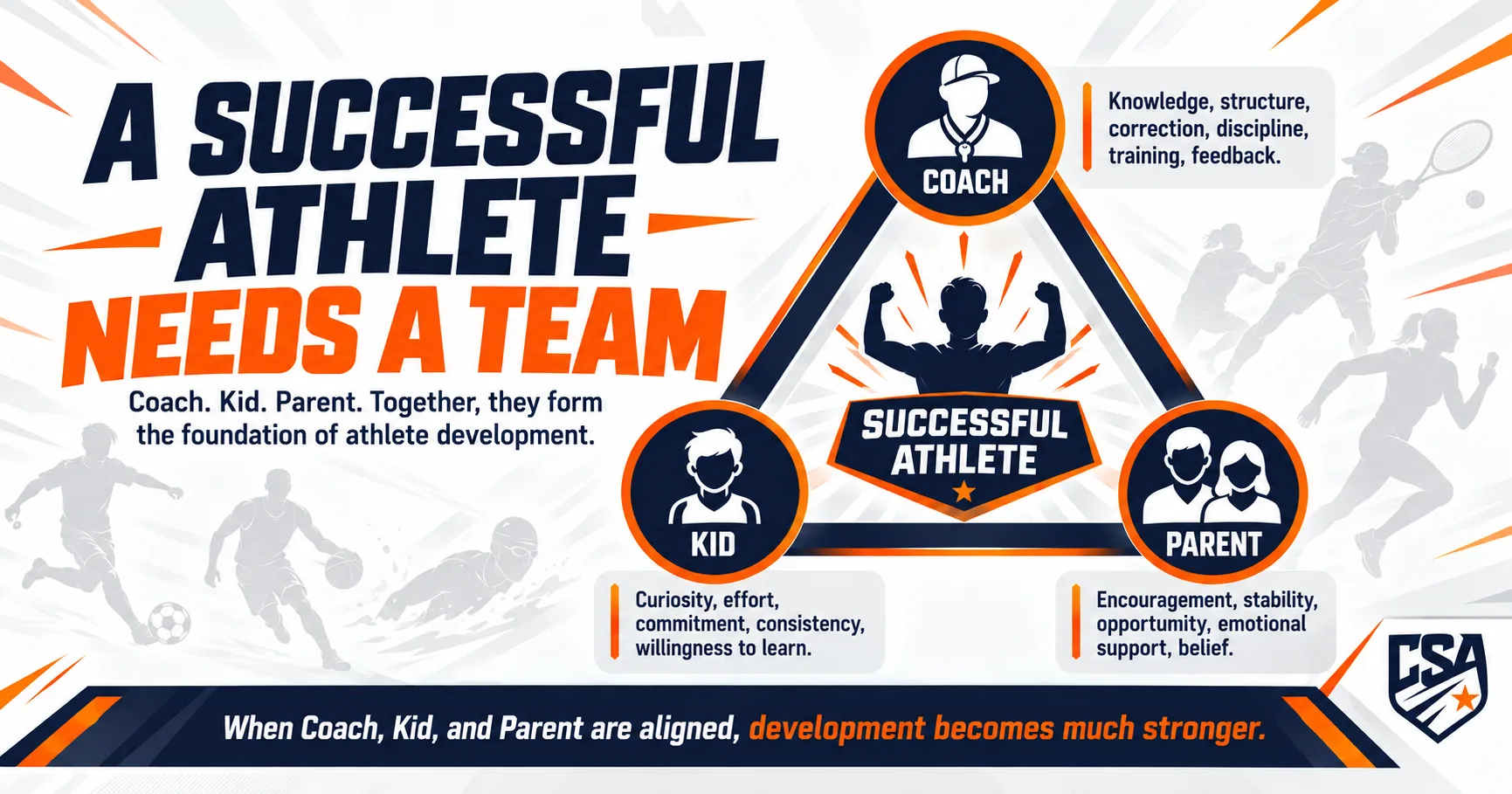
We strongly believe that no athlete is developed by one person alone.
There are three important people in every young athlete’s journey:
Coach.
Kid.
Parent.
Together, they form the foundation of athlete development.
The Coach
The coach provides knowledge, structure, correction, discipline, training, and feedback.
Whether the sport is badminton, football, cricket, athletics, basketball, tennis, swimming, or another discipline, the coach helps the athlete understand what to work on and how to improve.
The Kid
The child brings curiosity, effort, commitment, consistency, and willingness to learn.
No training system can succeed without the athlete’s own participation and mindset.
The Parent
Parents provide encouragement, stability, opportunity, emotional support, and belief.
Their role is not to become another coach.
Their role is to understand the journey and support it in the right way.
When Coach, Kid, and Parent are aligned, development becomes much stronger.
At CSA, we want to provide high-quality sports infrastructure.
Good courts matter.
Good playing surfaces matter.
Equipment matters.
Structured training spaces matter.
Technology matters.
Safety matters.
But infrastructure alone cannot build an athlete.
Even the best sports facility is only an environment.
Real development happens when infrastructure supports:
Good coaching.
Consistent training.
Clear goals.
Proper assessment.
Player effort.
Parent support.
CSA aims to bring all of these together.
One of the biggest mistakes in youth sports is measuring development only through wins and losses.
A child can lose a match and still make tremendous progress.
A child can win and still have several important areas to improve.
A runner can improve technique without winning a medal.
A football player can make better decisions even without scoring.
A badminton player can show better movement and resilience even after losing a match.
That is why we believe athlete development must be viewed across multiple dimensions.
Every sport has its own technical foundation.
For a badminton player, it may include:
grip
strokes
footwork
serves
movement efficiency
For a football player:
passing
ball control
shooting
first touch
For cricket:
batting technique
bowling mechanics
fielding
movement
Every sport is different, but the principle is the same.
Technical growth should be understood and tracked over time.
Sport is not just about physical skill.
Athletes must learn how to think.
When should they attack?
When should they defend?
How should they respond to an opponent?
How should they position themselves?
How should they change strategy during competition?
Tactical awareness becomes more important as athletes progress.
CSA believes decision-making and game understanding should be part of development, not something left to chance.
Sport constantly challenges emotions.
How does an athlete react after making a mistake?
Can they recover after losing a point?
Can they stay calm under pressure?
Can they remain confident after defeat?
Can they stay focused?
Can they learn positive self-talk?
Mental development is as important as technical development.
Confidence, resilience, discipline, patience, and emotional control can influence not only sporting performance, but life outside sport as well.
Every sport requires physical preparation.
Depending on the sport, development may involve:
speed
agility
endurance
strength
mobility
balance
coordination
flexibility
recovery
Young athletes should gradually build physical foundations appropriate to their age and sport.
Fitness should support performance, reduce injury risk, and help athletes move better.
Competition is important.
But the final score should not be the only thing we measure.
We should also understand:
how the athlete performed
what worked well
what went wrong
whether decision-making improved
whether confidence improved
whether technique held up under pressure
how the athlete responded to difficult moments
Competition should give us information.
That information should then improve training.
Every athlete should know what they are working toward.
The goal may be small.
Improve one skill.
Improve fitness.
Reduce unforced errors.
Build confidence.
Move to the next training level.
Compete in a first tournament.
Reach a state or national level.
Different children will have different ambitions.
What matters is that development has direction.
Small milestones eventually create meaningful progress.
At CSA, we do not believe in rushing every child toward competition.
Before building champions, we need to build foundations.
A strong athlete needs:
Technique
Movement
Fitness
Discipline
Confidence
Decision-making
Consistency
Sportsmanship
Mental strength
Respect
These foundations are valuable across every sport.
They also help children outside sport.
That is why we see sport as more than training for competition.
Sport can help build the person.
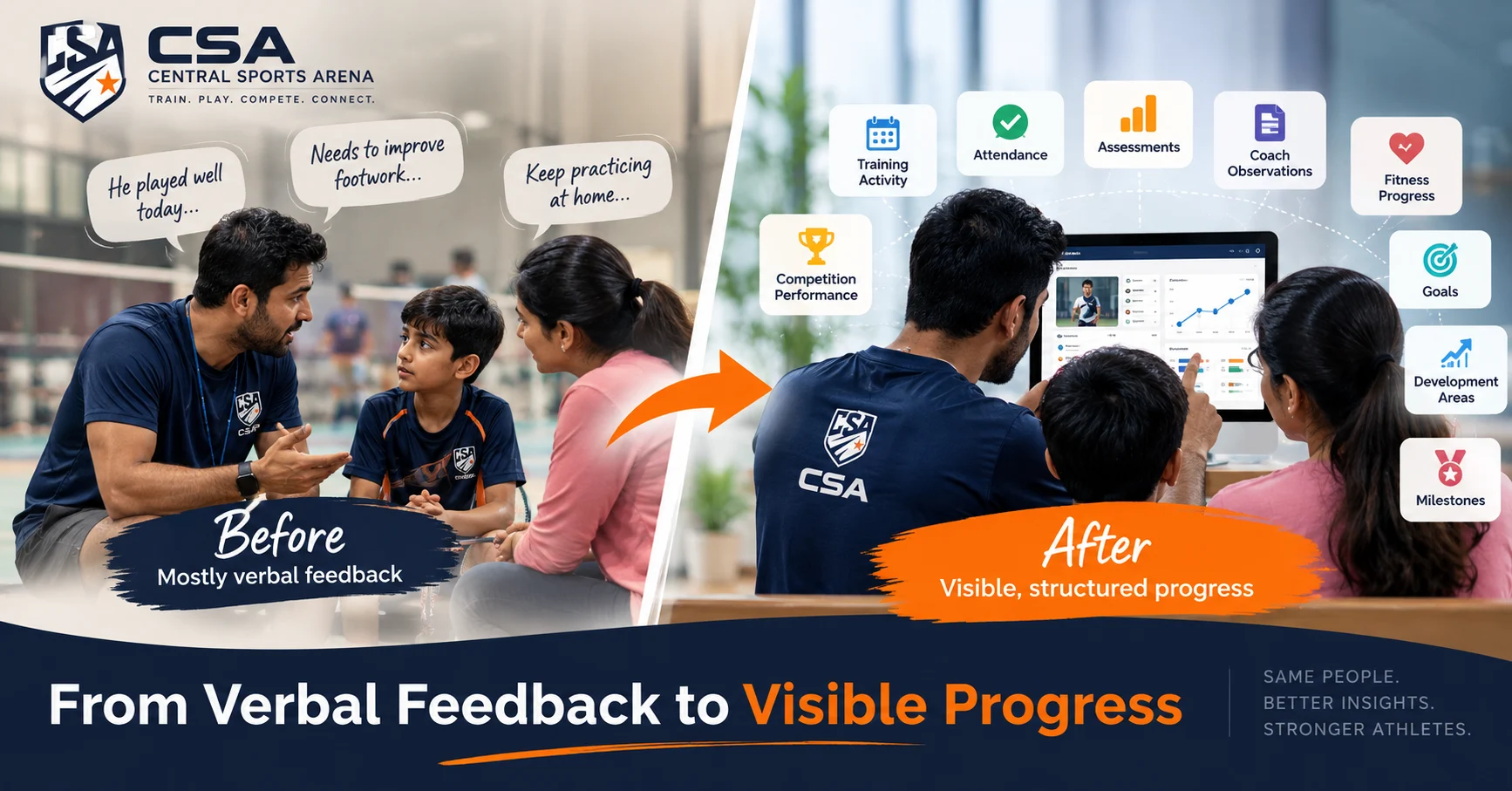
One of our major goals at CSA is to move athlete development from memory and occasional verbal feedback toward structured, visible progress.
Coaches should still talk to parents.
Human communication will always remain essential.
Technology should never replace the coach.
Instead, technology should help coaches capture and communicate development more effectively.
We want to make it easier to understand:
training activity
attendance
assessments
coach observations
fitness progress
competition performance
goals
development areas
milestones
This is one of the reasons we continue to build the CSA platform alongside our physical sports environment.
Our long-term vision is simple:
Technology and coaching should work together.
Over time, we want parents to be able to answer questions like:
What has my child improved in?
What are their current strengths?
Where do they need support?
What is the coach currently working on?
How consistent has training been?
How are they developing physically?
How are they developing mentally?
Are they becoming tactically smarter?
What should they work on next?
That is what transparency means to us.
Not more reports for the sake of reports.
Better understanding.
This philosophy is not only about parents.
Coaches also need better tools.
When one coach is working with many athletes, remembering every observation over several months becomes difficult.
Structured data can help coaches identify patterns.
For example:
Has this athlete improved in the last three months?
Is the same technical mistake continuing?
Has attendance affected progress?
Has fitness improved?
What did we identify during the previous assessment?
What should the next training cycle focus on?
Better information can help coaches make better decisions.
Children should also understand that progress does not happen overnight.
Visible progress can be extremely motivating.
An athlete may realise:
“My stamina has improved.”
“My movement is better.”
“I am making better decisions.”
“I stay calmer after mistakes.”
“My technique has improved.”
“I completed my first competition.”
“I moved to the next level.”
These small wins matter.
They build confidence.
And confidence supports consistency.
This is one of the most important principles behind CSA.
Transparency should never become pressure.
Tracking progress should never mean constantly comparing one child with another.
Every athlete develops differently.
Some develop technically faster.
Some develop physically later.
Some take longer to build confidence.
Some may become elite competitors.
Others may play sport for fitness, friendships, discipline, and enjoyment.
Both journeys are valuable.
Our goal is to help each child improve from where they are today.
At the heart of CSA is a simple idea:
Coach + Kid + Parent
When these three work together, supported by the right environment, development becomes stronger.
The coach understands the athlete.
The child understands what they are working toward.
The parent understands how to support the journey.
CSA’s role is to build the environment around them:
Quality Infrastructure
Structured Training
Technology
Progress Tracking
Communication
Competition Opportunities
Development Programs
Community
All working together.

Badminton is where our journey began.
It helped us understand the challenges faced by children, parents, coaches, and academies.
But the principles we believe in are not limited to one sport.
Transparency matters in every sport.
Structured development matters in every sport.
Mental strength matters in every sport.
Physical fitness matters in every sport.
Coach–parent communication matters in every sport.
And every young athlete deserves to understand their own journey.
That is why we see CSA as a broader sports development ecosystem.
CSA exists because we believe youth sports can be better.
We believe parents deserve visibility.
We believe coaches deserve better tools.
We believe children deserve structured development.
We believe progress should be understood, not guessed.
And we believe building an athlete requires much more than teaching sport-specific skills.
It requires:
Physical development.
Technical development.
Tactical understanding.
Mental strength.
Consistency.
Communication.
Support.
Opportunity.
Time.
Most importantly, it requires Coach, Kid, and Parent to move in the same direction.
That is the foundation we are trying to build at Central Sports Arena.
Not just better players.
Better athletes.
Stronger individuals.
More confident children.
And a lifelong connection with sport.
Train. Play. Compete. Connect.
Central Sports Arena
Building Better Athletes. Stronger People. Brighter Futures.
Explore CSA: Health calculators · Water intake · Protein intake · Youth badminton training
Recommended For You

Health & Nutrition
Hydration for Young Athletes
Learn how to keep young athletes properly hydrated before, during and after training. Part 3 covers daily water needs, signs of dehydration, electrolytes, sports drinks, hot-weather training and simple tournament-day hydration habits.
Oct 17, 2026

Health & Nutrition
What Should Kids Eat Before & After Sports Training?
Help young athletes fuel training and recover better with simple food choices and smart timing. This guide covers what kids can eat before and after sports, with practical Indian meal and snack ideas for morning, evening and heavier training days.
Oct 11, 2026

Health & Nutrition
Nutrition Basics for Young Athletes
Good nutrition helps young athletes grow, train, recover and perform at their best. In Part 1 of our Health & Nutrition for Young Athletes series, we cover the basics of balanced meals, protein, hydration, meal timing, recovery and healthy habits for growing children.
Oct 4, 2026